


All Products
-
Thermal Camera Core
-
Thermal Security Camera
-
Plug-in Thermal Camera
-
Cooled Infrared Detectors
-
Cooled Camera Modules
-
Optical Gas Imaging
-
Radiometric Thermal Module
-
High Resolution Thermal Camera Module
-
Thermal Camera For Fever Detection
-
Vehicle Mounted Thermal Camera
-
Integrated Dewar Cooler Assembly
-
Uncooled Infrared Detectors
Contact Person :
Wendy Wang
Phone Number :
+86 27 50185150
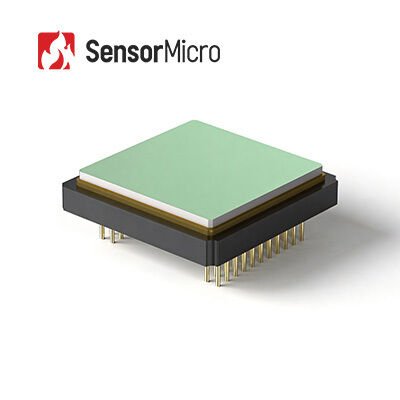
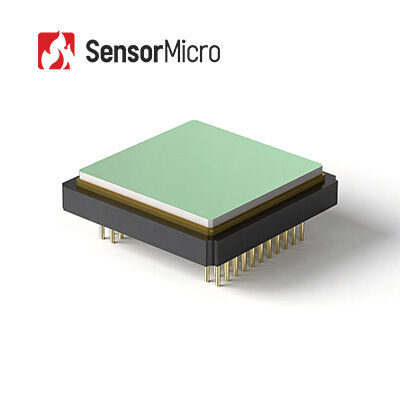
400x300 Resolution 12μm Pixel Size Uncooled FPA Thermal Imaging Detector with Ceramic Package

| Place of Origin | Wuhan, Hubei Province, China |
|---|---|
| Brand Name | SensorMicro |
| Certification | ISO9001:2015; RoHS; Reach |
| Model Number | Apex412C |
| Minimum Order Quantity | 100 Pieces |
| Price | Negotiable |
| Payment Terms | L/C,T/T |
Product Details
| Resolution | 400x300 / 12μm | NETD | <35mK |
|---|---|---|---|
| Spectral Range | 8~14μm | Size | 18.5×18.5×3.8 (Without Pin Size) |
| Highlight | Uncooled FPA Thermal Imaging Detector,400x300 Thermal Imaging Detector,12um Uncooled Infrared Detectors |
||
Product Description
400x300/12μm Uncooled FPA Thermal Imaging Detector with Ceramic Package
Product Overview
The Apex412C uncooled infrared detector is a new infrared product developed by SensorMicro. Utilizing international mainstream vanadium oxide material, this detector delivers outstanding comprehensive performance. The vanadium oxide (VOx) microbolometer detector covers long wavelengths from 8 to 14μm with a resolution of 400x300 and pixel size of 12μm.
Ceramic packaging represents the most advanced packaging technology currently available, significantly reducing detector size, weight, and power consumption. When integrated into infrared cameras, this ceramic-packaged detector produces clear, sharp thermal images.
This innovative ceramic package infrared detector provides enhanced options for customers across various industries including Industrial Automation, Intelligent Security, Unmanned Platforms, Robotics, Intelligent Hardware, Advanced Driver Assistance Systems, and Firefighting.
Main Features
- High thermal sensitivity, NETD < 35mK
- Frame rate up to 50Hz
- Miniature size: 18.5mm * 18.5mm * 3.8mm
- Light weight: less than 4.5g
- Low power consumption: 140mW
Product Specifications
| Model | Apex412C |
|---|---|
| Sensitive Material | VOx |
| Package | Ceramic |
| Resolution | 400*300 |
| Pixel Size | 12μm |
| Spectral Response | 8μm~14μm |
| NETD | < 35mK |
| Output Signal | Built-in 14 bits ADC |
| Thermal Response Time | < 12ms |
| Max. Frame Rate | 50Hz |
| Power Consumption | < 140mW |
| Size (mm) | 18.5*18.5*3.8 |
| Weight (g) | < 4.5 |
| Operating Temperature | -40℃ ~ +85℃ |
Industrial Applications
The Apex412C thermal imaging detector is widely used in many areas, including ADAS, Security Monitoring, Handheld Devices, Machine Vision, Thermography, Power Maintenance, Metallurgy Petrochemical, and Scientific Research.
Our Advantages
- Deep Technical Expertise: With many years of experience in infrared sensor technology research, development, and application, we possess strong capabilities across chip design, wafer fabrication, packaging and testing, and system integration.
- Focused on Innovation: We are committed to driving technological breakthroughs in thermal imaging, constantly pushing boundaries in NETD, SWaP, and operating temperature across security, industrial monitoring, and intelligent systems.
- Diversified Product Portfolio: Backed by independent R&D and multiple technical pathways, we offer comprehensive infrared detection components—both cooled and uncooled—providing tailored solutions for various industries.
- Rigorous Reliability Validation: Supported by a robust quality management system, our products undergo multiple testing procedures to ensure long-term stability and reliability.
- Professional Technical Support: Our engineering team works closely with customers' R&D teams to accelerate system integration, improve efficiency, and shorten time-to-market.
Frequently Asked Questions
What is infrared thermal imaging?
Infrared thermal imaging is a method of using infrared radiation and thermal energy to gather information about objects, in order to formulate images of them, or get temperature information of the objects, even in low visibility environments.
How does Infrared Thermal Imaging Work?
Infrared thermal imaging system is a passive non-contact detection and identification technology. It focuses the infrared radiation of the scene on the focal plane array infrared detector through infrared optical systems. The thermal detector converts radiation signals of different intensity into corresponding electrical signals, which are then amplified and processed to form infrared images observable by the naked eye.
Recommended Products
-

-
VIDEO VIDEO