


All Products
-
Thermal Camera Core
-
Thermal Security Camera
-
Plug-in Thermal Camera
-
Cooled Infrared Detectors
-
Cooled Camera Modules
-
Optical Gas Imaging
-
Radiometric Thermal Module
-
High Resolution Thermal Camera Module
-
Thermal Camera For Fever Detection
-
Vehicle Mounted Thermal Camera
-
Integrated Dewar Cooler Assembly
-
Uncooled Infrared Detectors
Contact Person :
Wendy Wang
Phone Number :
+86 27 50185150
High Sensitivity 400x300 Resolution 17μm Pixel Size VOx Microbolometer Uncooled Infrared Detector

| Place of Origin | Wuhan, Hubei Province, China |
|---|---|
| Brand Name | SensorMicro |
| Certification | ISO9001:2015; RoHS; Reach |
| Model Number | Apex417C |
| Minimum Order Quantity | 100 Pieces |
| Price | Negotiable |
| Payment Terms | L/C,T/T |
Product Details
| Sensor | FPA Vanadium Oxide | Size | 30x19.8x7.32mm |
|---|---|---|---|
| Type | Uncooled Microbolometer | Resolution | 400x300 / 17μm |
| NETD | <30mK | Spectral Range | 8~14μm |
| Highlight | High Sensitivity VOx Thermal Sensor,400x300 VOx Thermal Sensor,Harsh Environments Uncooled Infrared Detectors |
||
Product Description
High Sensitivity VOx Thermal Sensor 400x300 / 17μm for Harsh Environments
High Sensitivity 400x300 / 17 μm Thermal Imaging Detector for Harsh Environments
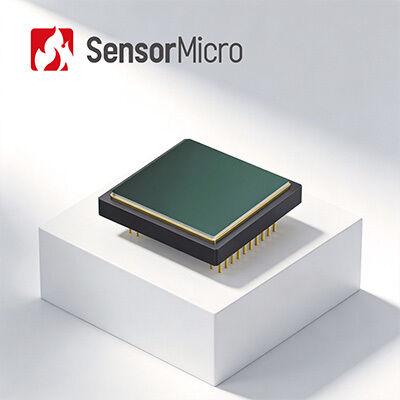
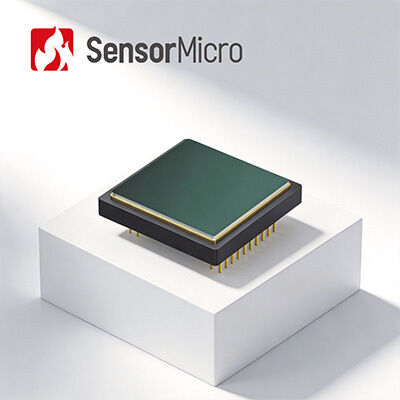
Apex417C is one of the ceramic packing uncooled focal plane array detectors developed by SensorMicro. With standard 400x300 QVGA format at 17μm, the Apex417C uncooled microbolometer sensor will exceed your most demanding requirements.
Based on ceramic package technics and TEC technology, Apex417C thermal imaging detector sensor has high sensitivity, stable performance characteristics and can present clear imaging quality in various kinds of harsh working environment such as total darkness, thick fog, heavy rain, snow, sand storm etc.
As a leading infrared detector and thermal imaging module supplier, SensorMicro has provided the customers with various mature and stable infrared thermal imaging solutions.
Main Features
- NETD<30mk, High Sensitivity
- Mature Technology
- Stable Performance
- Long Operating Life
- Clear Image Quality & Details
- Strong Environmental Adaptability
Product Specifications
| Model | Apex417C |
| Sensitive Material | VOx |
| Package | Ceramic |
| Resolution | 400*300 |
| Pixel Size | 17μm |
| Spectral Response | 8μm~14μm |
| NETD | ﹤30mK |
| Output Signal | Built-in 14 bits ADC |
| Thermal Response Time | ﹤12ms |
| Max. Frame Rate | 50Hz |
| Power Consumption | ﹤180mW |
| Size(mm) | 18.5*18.5*3.8 |
| Weight(g) | ﹤4.5 |
| Operating Temperature | -40℃ ~ +85℃ |
Industrial Applications
The Apex417C thermal imaging detector is widely used in many areas, such as Thermography, Security & Monitoring, Outdoors, Law Enforcement & Rescue, ADAS etc.
Our Advantages
A wide range of product formats including infrared detectors, camera cores, and modules to meet various integration requirements.
Rich Product Variety
Multiple array resolutions, pixel sizes, wavebands, and lens options combinations provide greater flexibility for diverse applications.
Outstanding Performance
Clear imaging, compact size, low power consumption, high sensitivity, and strong reliability--designed to perform under a wide range of environmental challenges.
Easy Integration
Multiple interface options make integration straightforward and enable rapid development across multiple application fields.
FAQs
1. How does uncooled focal plane array microbolometer work?
By using the principle of infrared radiant thermal effect, the uncooled infrared detector converts infrared radiation energy into heat energy with infrared absorption material, so that the temperature of the sensitive material increases. Then, a certain physical parameter of the sensitive material changes accordingly and converts into electrical signal or visible light signal through a certain conversion mechanism designed to realize the detection of the object.
2. What's the advantage of uncooled vox microbolometer?
Uncooled infrared focal plane detector does not need an Integrated Dewar Cooler Assembly (IDCA) device and can work at room temperature. It has the advantages of fast start, low power consumption, small size, light weight, long life, low cost and so on. Although the sensitivity of uncooled infrared focal plane detector is not as good as that of cooled infrared detectors, after years of development, its cost performance has been obviously better than the cooled detector, which has a broader application prospect.
Recommended Products
-

-
VIDEO