


All Products
-
Thermal Camera Core
-
Thermal Security Camera
-
Drone Thermal Camera
-
Plug-in Thermal Camera
-
Cooled Infrared Detectors
-
Cooled Camera Modules
-
Optical Gas Imaging
-
Infrared Thermal Camera Module
-
High Resolution Thermal Camera Module
-
Thermal Camera For Fever Detection
-
Vehicle Mounted Thermal Camera
-
Integrated Dewar Cooler Assembly
-
Uncooled Infrared Detectors
Contact Person :
Wendy Wang
Phone Number :
+86 27 50185150
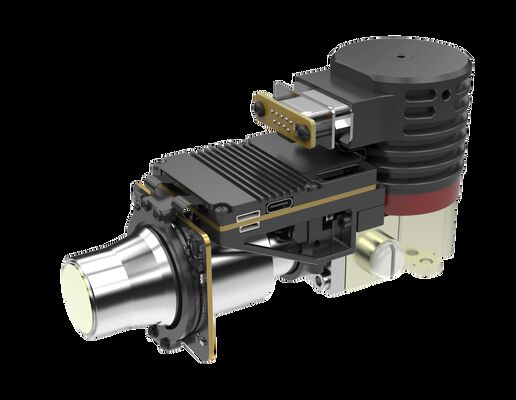
320x256 Resolution 10.3-10.9μm Spectral Range 20mK NETD Cooled Thermal Imaging Module for Gas Leak Detection

| Place of Origin | Wuhan, Hubei Province, China |
|---|---|
| Brand Name | SensorMicro |
| Certification | RoHS; Reach |
| Model Number | LFM330C2 |
| Minimum Order Quantity | 1 Piece |
| Price | Negotiable |
| Payment Terms | L/C,T/T |
Product Details
| Spectral Range | 10.3±0.1μm~10.9±0.1μm | Detector Resolution | 320x256 |
|---|---|---|---|
| Communication | Standard: USB2.0/LV-TTL; Optional: RS422/CAN/USB3.0/GigE | Pixel Size | 30μm |
| NETD | 20mK (F1.5) | Function | Gas Leak Detection |
| Highlight | RS058 Thermal Imaging Module,MWIR Cooled Thermal Imaging Module,Optical Gas Imaging 320x256 |
||
Product Description
LWIR Cooled 320x256 Gas Leak Detection Thermal Imaging Module
320x256 30 μM MWIR Cooled Optical Gas Imaging Thermal Module
Sulfur hexafluoride (SF₆) is commonly used in high-voltage power equipment and has a strong greenhouse effect. Ammonia, as a widely used refrigerant in industrial refrigeration systems, is highly toxic and volatile.
The LFM330C2 thermal module is developed based on type II superlattice (T2SL) technology, which performs exceptionally well in sensitivity, stability, and integration flexibility. It is an ideal choice for detecting gases such as sulfur hexafluoride (SF₆), ammonia, and ethylene.
Main Features
- Advanced Technology: Developed using T2SL technology with high quantum efficiency
- Easy Integration: Supports various interfaces and RAW/YUV image output
- High Sensitivity: Superior detection capabilities for gas leak identification
Product Specifications
| Module Model | LFM330C2 |
| Resolution | 320×256 |
| Pixel Size | 30μm |
| Spectral Response | 10.3±0.1μm~10.9±0.1μm |
| Typical NETD | 20mK (F1.5) |
| Frame Rate | 60Hz |
| Digital Video | Standard: DVP/LVDS/USB2.0 Optional: Cameralink/USB3.0/GigE/SDI/MIPI/Single-mode fiber/Multi-mode fiber |
| Communication | Standard: USB2.0/LV-TTL Optional: RS422/CAN/USB3.0/GigE |
| Cooling Time (23℃) | ≤8min@24V |
| Stable Power Consumption (23℃) | ≤13W |
| Size (mm) | 142×58.5×80 |
| Weight (g) | ≤680 |
| Working Temperature | -40℃~+71℃ |
| Focal Length | 25mm |
Industrial Applications
The LFM330C2 gas leak detection thermal imaging camera is used for detecting various industrial gases including:
- Sulfur hexafluoride
- Anhydrous ammonia
- Cyanoacrylate ethyl ester
- Chlorine dioxide
- Acetic acid
- Freon-12
- Ethylene
- Methyl ethyl ketone
- Acetyl chloride
- Allyl bromide
- Allyl chloride
- Allyl fluoride
- Bromomethane
- Freon-11
- Furan
- Hydrazine
- Methylsilane
- Methylvinyl ketone
- Acrolein
- Propene
- Tetrahydrofuran
- Trichloroethylene
- Uranyl fluoride
- Vinyl chloride
- Vinyl cyanide
Customized Services
- Product Customization: Adjust configurations and adapt algorithms to meet industry-specific requirements
- On-Site Technical Support & Training: Provide core customers with hands-on system setup and operational training
- Joint Innovation for New Products & Markets: Collaborate with customers to co-develop innovative infrared application solutions
Frequently Asked Questions
What is infrared thermal imaging?
Infrared thermal imaging utilizes infrared radiation and thermal energy to gather information about objects. It converts invisible infrared radiation into visible infrared thermal images that display temperature distribution of the target surface. Different objects and even different parts of the same object have different radiation ability and infrared reflection strength.
What can infrared imaging be used for?
- Night vision
- Search & rescue
- Non-destructive testing
- Epidemic prevention
- Thermography
- Security & monitoring
- Firefighting
What is a thermal imaging module?
A thermal imaging module typically consists of an infrared detector, infrared lens, and hardware electronics with embedded software and algorithms. It represents the minimum functional unit of a thermal imaging device.
Recommended Products
