


All Products
-
Thermal Camera Core
-
Thermal Security Camera
-
Plug-in Thermal Camera
-
Cooled Infrared Detectors
-
Cooled Camera Modules
-
Optical Gas Imaging
-
Radiometric Thermal Module
-
High Resolution Thermal Camera Module
-
Thermal Camera For Fever Detection
-
Vehicle Mounted Thermal Camera
-
Integrated Dewar Cooler Assembly
-
Uncooled Infrared Detectors
Contact Person :
Wendy Wang
Phone Number :
+86 27 50185150
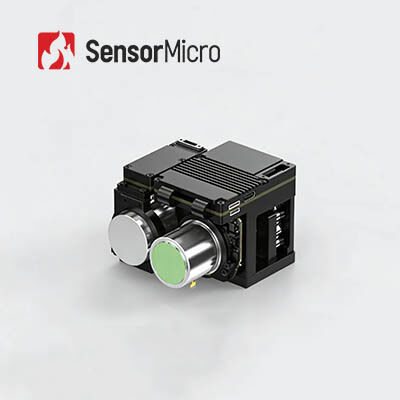
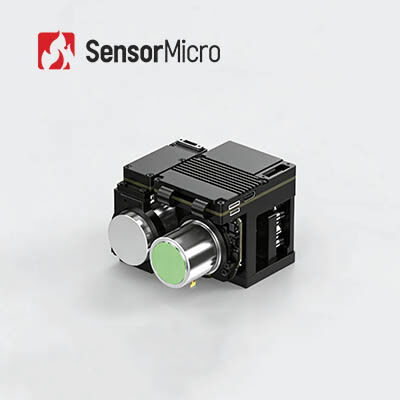
640×512 Resolution 15μm Pixel Size Optical Gas Imaging Camera with 3.2-3.5μm Spectral Range for Gas Leak Detection

| Place of Origin | Wuhan, Hubei Province, China |
|---|---|
| Brand Name | SensorMicro |
| Certification | ISO9001:2015; RoHS; Reach |
| Model Number | LFM615HZ3 |
| Minimum Order Quantity | 1 Piece |
| Price | Negotiable |
| Payment Terms | T/T |
Product Details
| Function | Gas Leak Detection | Cooling Time (23 ℃) | ≤5min@12V |
|---|---|---|---|
| Detector Resolution | 640x512 | Pixel Size | 15μm |
| Typical NETD | 25mK (F1.5) | Spectral Range | 3.2±0.1~3.5±0.1μm |
| Highlight | OGI Optical Gas Imaging Camera,30Hz Optical Gas Imaging Camera,15mK Optical Gas Imaging Camera |
||
Product Description
640*512 / 15μm MWIR Cooled Optical Gas Imaging Camera for Visualizing Gas Leaks
Optical Gas Imaging (OGI) is an innovative thermal imaging technology that utilizes high sensitivity infrared cameras for detecting minute fugitive emissions of industrial gases.
The LFM615HZ3 Cooled Optical Gas Imaging Camera can detect gas leaks that are hazardous for human health and the environment by visualizing them. This thermal camera module features a cooled infrared detector with a resolution of 640*512, pixel size of 15µm, and spectral range of 3.2~3.5μm.
Based on industry-leading T2SL technology route and HOT device technology, the LFM615HZ3 thermal module offers prominent SWaP³ performance advantages, achieving more accurate leak detection performance, comprehensive coverage of common VOCs gas types, and significantly improved safe operation levels.
The LFM615HZ3 thermal camera module enables non-contact detection, ensuring inspector safety while improving quality, efficiency, and cost savings.
Main Features
- Resolution: 640*512
- Pixel Pitch: 15µm
- Spectral Response: 3.2µm±0.1µm~3.5µm±0.1µm
- Wavelength Customizable Based on Different Requirements
- Integrate with DVP/CameraLink Interface Easily
Product Specifications
| Module model | LFM615HZ3 |
|---|---|
| Resolution | 640*512 |
| Pixel size | 15μm |
| Spectral response | 3.2±0.1μm~3.5±0.1μm |
| Typical NETD | 25mK (F1.5) |
| Frame rate | 30Hz |
| Digital video | USB3.0/GigE/MIPI |
| Communication | USB3.0/GigE/RS422 |
| Cooling time (23 ℃) | ≤5min@12V |
| Stable power consumption (23 ℃) | ≤8.5W |
| Size (mm) | 71*72*52 |
| Weight (g) | ≤370 |
| Working temperature | -40℃~+71℃ |
| Focal length | 23mm/55mm/25-75mm |
Industrial Applications
The LFM615HZ3 gas leak detection thermal imaging camera is used for visualizing invisible VOCs (volatile organic compounds) and detecting gas leakage including: Methane, Ethane, Propane, Butane, Pentane, Hexane, Heptane, Octane, Ethylene, Propylene, Isoprene, Methanol, Ethanol, Butanone, Benzene, Xylene, Ethylbenzene, and more.
Product Advantages
Diverse Product Portfolio
A wide range of product formats including infrared detectors, camera cores, and modules to meet various integration requirements.
Rich Product Variety
Multiple array resolutions, pixel sizes, wavebands, and lens options combinations provide greater flexibility for diverse applications.
Outstanding Performance
Clear imaging, compact size, low power consumption, high sensitivity, and strong reliability—designed to perform under a wide range of environmental challenges.
Easy Integration
Multiple interface options make integration straightforward and enable rapid development across multiple application fields.
Frequently Asked Questions
What is the difference between low light, active IR and thermal imaging?
Low light needs natural light and transforms weak natural light image into enhanced electronic image through image intensifier.
Active IR actively emits infrared light and uses infrared beam reflected by the target. It has very poor concealment.
Thermal imaging doesn't need any light and is a passive infrared night vision that detects infrared radiation difference between targets and scene or different parts of an object. It is not affected by changes in surrounding lighting conditions, during night or even in fog, rain and other harsh environments.
Active IR actively emits infrared light and uses infrared beam reflected by the target. It has very poor concealment.
Thermal imaging doesn't need any light and is a passive infrared night vision that detects infrared radiation difference between targets and scene or different parts of an object. It is not affected by changes in surrounding lighting conditions, during night or even in fog, rain and other harsh environments.
Can you block thermal imaging?
In most cases, you cannot. However, infrared rays cannot penetrate walls, and glass can block IR. To avoid detection, you can conceal behind glass or walls to block thermal imaging.
Recommended Products
