


All Products
-
Thermal Camera Core
-
Thermal Security Camera
-
Plug-in Thermal Camera
-
Cooled Infrared Detectors
-
Cooled Camera Modules
-
Optical Gas Imaging
-
Radiometric Thermal Module
-
High Resolution Thermal Camera Module
-
Thermal Camera For Fever Detection
-
Vehicle Mounted Thermal Camera
-
Integrated Dewar Cooler Assembly
-
Uncooled Infrared Detectors
Contact Person :
Wendy Wang
Phone Number :
+86 27 50185150
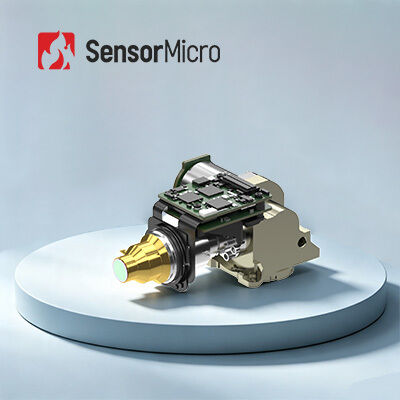
EYAS G615MB MWIR Cooled Camera Module with 640x512 Resolution and 15μm Pixel Size for Easy Integration

| Place of Origin | China |
|---|---|
| Brand Name | SensorMicro |
| Certification | ISO9001:2015; RoHS; Reach |
| Model Number | EYAS G615MB |
| Minimum Order Quantity | 1 Piece |
| Price | Negotiable |
| Payment Terms | T/T |
Product Details
| Resolution | 640x512 / 15μm | NETD | 20mK(F4); 25mK(F5.5) |
|---|---|---|---|
| Spectral Range | 3.7~4.8μm | Size | 122×86×60mm |
| Cooling Time(23℃) | ≤5min30s | Weight | ≤400g |
| Highlight | MWIR Infrared Thermal Imaging Module,640x512 Infrared Thermal Imaging Module,15μM MWIR Thermal Module |
||
Product Description
EYAS G615MB Cooled MWIR Infrared Thermal Imaging Module Easy Integration 640x512 / 15μm
Easy Integration 640x512/15 μm MCT MWIR Cooled Infrared Thermal Module
EYAS series cooled AD modules feature pre-amplifier functionality to convert analog signals from cooled IR detectors into digital video stream output. Available in various resolution formats and wave bands to suit different application requirements.
The EYAS G615MB cooled AD module integrates a 640×512/15μm MWIR cooled infrared detector with an AD circuit board and RS046 rotary Stirling cryocooler. This module converts analog output signals from cooled infrared detectors into digital video streams while providing drive power and control timing. Designed to help OEM customers quickly test and verify detectors, it simplifies integration between cooled infrared detectors and complete systems, significantly accelerating development progress.
As an infrared detector supplier and OEM infrared thermal core manufacturer, we provide customers with various mature and effective thermal imaging solutions.
Main Features
- Analog-to-Digital Conversion, Accelerated Development - Based on 640x512 MWIR cooled infrared detectors with integrated AD circuit for analog-to-digital conversion. Integrated design with dimensions consistent with the detector.
- Mid-wave Cooled Infrared for High Versatility - Mid-wave cooling with excellent consistency and stable supply. Mainstream resolution offering broad adaptability.
- Excellent Performance, Easy Integration - Adjustable high frame rate from 1 to 100 Hz for capturing fast-moving targets. Cameralink interface outputs 16-bit raw data with serial port control.
Product Specifications
| Model | EYAS G615MB |
|---|---|
| Indicators | |
| Resolution | 640×512 |
| Pixel Size | 15μm |
| Spectral Response | 3.7μm±0.2μm~4.8μm±0.2μm |
| IR Detector NETD(23℃) | 20mK(F4) 25mK(F5.5) |
| Working Mode | |
| Frame Rate | 1~ 100Hz, adjustable |
| Working Mode | Snapshot ITR/IWR Integration Modes Anti-blooming Windows Mode |
| Electrical | |
| Standard External Interface | 60pin: 37201-SM060-032W1R01 5pin: A1257WR-S-5P-LCP |
| Digital Video | 16 bit CameraLink (CameraLink Base mode) |
| External Sync | CC1: External frame synchronous |
| Communication | CameraLink UART (Default)/ RS232 (customizable) Baud rate: 9600bps (Default) |
| Power Supply | AD Board: 5V Cryocooler: 12V |
| Steady Power (23℃) | ≤8.5W |
| Cooling Time (23℃) | ≤5min30s |
| Size (mm) | 122×86×60 |
| Weight (g) | ≤400 |
| Operating Temperature | -40℃~+71℃ |
Industrial Applications
The EYAS G615MB thermal imaging module is widely used in many areas including NDT, Environmental Monitoring, Long-Range Surveillance, Scientific Research, and more.
Diverse Product Portfolio
- Wide Range of Product Formats - Comprehensive selection including infrared detectors, camera cores, and modules to meet various integration requirements.
- Rich Product Variety - Multiple array resolutions, pixel sizes, wavebands, and lens options combinations providing greater flexibility for diverse applications.
- Outstanding Performance - Clear imaging, compact size, low power consumption, high sensitivity, and strong reliability—designed to perform under a wide range of environmental challenges.
- Easy Integration - Multiple interface options make integration straightforward and enable rapid development across multiple application fields.
Frequently Asked Questions
1. What are the advantages of uncooled infrared detectors?
Uncooled infrared focal plane detectors operate without cooling devices and work at room temperature. They offer advantages including fast start-up, low power consumption, small size, light weight, long lifespan, and lower cost.
2. What are the key considerations for an infrared detector / thermal module for your application?
- The detector resolution
- The pixel size
- The NETD
- The image quality
- The lens options
- The power consumption
- The size and weight
- The mechanical & electrical interface
- The budget
Recommended Products
-
VIDEO

-