


All Products
-
Thermal Camera Core
-
Thermal Security Camera
-
Plug-in Thermal Camera
-
Cooled Infrared Detectors
-
Cooled Camera Modules
-
Optical Gas Imaging
-
Radiometric Thermal Module
-
High Resolution Thermal Camera Module
-
Thermal Camera For Fever Detection
-
Vehicle Mounted Thermal Camera
-
Integrated Dewar Cooler Assembly
-
Uncooled Infrared Detectors
Contact Person :
Wendy Wang
Phone Number :
+86 27 50185150
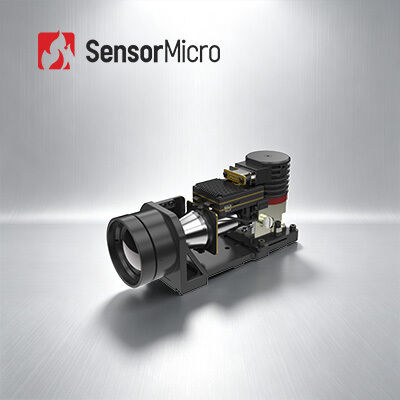
640×512 Resolution 25μm Pixel Pitch LWIR Cooled Infrared Camera Core for Long-range System Integration

| Place of Origin | China |
|---|---|
| Brand Name | SensorMicro |
| Certification | ISO9001:2015; RoHS; Reach |
| Model Number | GAVIN GC625LC |
| Minimum Order Quantity | 1 Piece |
| Price | Negotiable |
| Payment Terms | T/T |
Product Details
| Detector Type | Cooled LWIR Infrared Detector | IR Detector NETD (23℃) | 20mK (F2) |
|---|---|---|---|
| Resolution | 640x512 | Pixel Pitch | 25μm |
| Frame Rate | 100Hz/200Hz | Mid Wavelength | 7.7μm±0.2μm~9.4μm±0.3μm |
| Highlight | MWIR Miniature Camera Module,GAVIN615B Miniature Camera Module |
||
Product Description
640×512/25μm LWIR Cooled Infrared Camera Core for Long-range System Integration
Product Overview
The GAVIN GC625LC infrared camera core integrates a Type-II Superlattice (T2SL) 640×512/25μm LWIR cooled infrared detector. This advanced camera core incorporates multiple image processing algorithms, making it especially suitable for reconnaissance and detection in challenging environments such as dusty conditions or strong sunlight with reflective interference. Supporting various mainstream video interfaces, it provides easy development and flexible integration, making it an ideal choice for long-range, high-performance LWIR system integration.
With its compact size, the GAVIN GC625LC cooled infrared camera module enables easy integration into various systems or instruments, allowing integrators to conduct secondary development while significantly reducing the cost of thermal imaging applications.
Main Features
- Mainstream FPA, Larger Pixel Size - Developed with a 640×512/25μm LWIR cooled infrared detector for stable imaging and wide application, enhanced with next-generation image algorithms including DRC, 2D/3D noise reduction, and EE edge enhancement for clearer imaging
- LWIR with Resilience against Interference - Strong resistance to dust and glare, adaptable to complex environments, capable of detecting low-temperature objects, featuring Type-II Superlattice technology with excellent quantum efficiency and uniformity
- Rich Interfaces, Easy Integration - Multiple image interfaces: CameraLink/USB 3.0/GigE/HDMI/SDI/MIPI/Fiber, flexible RAW/YUV image data output
Product Specifications
| Model | GAVIN GC625LC |
|---|---|
| Indicators | |
| Resolution | 640×512 |
| Pixel Size | 25μm |
| Spectral Response | 7.7μm±0.2μm~9.4μm±0.3μm |
| IR Detector NETD(23℃) | 20mK(F2) |
| Image Processing | |
| Frame Rate | 100Hz/200Hz |
| Dimming Mode | Linear/Histogram/Mixed |
| Digital Zoom | 1× to 8× continuous digital zoom |
| Image Direction | Horizontally/Vertically/Diagonally Flip |
| Image Algorithm | DRC, 2D/3D Image Noise Reduction, EE |
| Electrical | |
| Digital Video | Standard: DVP Option: Cameralink/USB3.0/GigE/SDI/HDMI/MIPI/Single-mode Optical Fiber/Multi-mode Optical Fiber |
| External Sync | Standard: LV-TTL Option: RS422/LVDS |
| Communication | Standard: USB2.0/LV-TTL Option: RS422/CAN/USB3.0/GigE |
| Power Supply | 24V±4V |
| Steady Power Consumption(23℃) | ≤18W |
| Cooling Time(23℃) | ≤9min |
| Size(mm) | 148×59×81 |
| Weight(g) | ≤730 |
| Operating Temperature | -40℃~+71℃ |
| Optical Lens | |
| Lens Options | Fixed focus: 55mm/F2 |
Industrial Applications
The GAVIN GC625LC thermal infrared camera module is widely used in many areas such as NDT, Environmental Monitoring, Long-range Surveillance, Scientific Research, and more.
Our Advantages

Frequently Asked Questions
1. What is the difference between Cooled MCT & T2SL Detector?
Low light needs natural light and transforms weak natural light image into enhanced electronic image through image intensifier; Active IR actively emits infrared light and uses infrared beam reflected by the target. It has very poor concealment; Thermal imaging doesn't need any light and is a passive infrared night vision that detects infrared radiation difference between targets and scene or different parts of an object. It is not affected by changes in surrounding lighting conditions, during night or even in fog, rain and other harsh environments.
2. How to select right pseudo color for thermal imaging?
- The gray white is more suitable for targets with small temperature differences
- The red and blue is more suitable for scenes where problem points need to be found
- The iron red is the standard color palette of the power industry
Note: No matter which palette you choose, the thermal temperature will not change at all.
3. What is the advantage of infrared thermal imaging?
- See through total darkness
- Identification under camouflage
- Long range detection
- Heat distribution detection
- Non-contact temperature measurement
- Occupation awareness
- And so on
Recommended Products
-
VIDEO
-