


All Products
-
Thermal Camera Core
-
Thermal Security Camera
-
Plug-in Thermal Camera
-
Cooled Infrared Detectors
-
Cooled Camera Modules
-
Optical Gas Imaging
-
Radiometric Thermal Module
-
High Resolution Thermal Camera Module
-
Thermal Camera For Fever Detection
-
Vehicle Mounted Thermal Camera
-
Integrated Dewar Cooler Assembly
-
Uncooled Infrared Detectors
Contact Person :
Wendy Wang
Phone Number :
+86 27 50185150
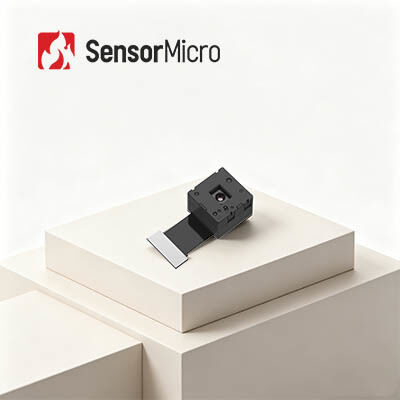
LWIR 120x90 Resolution 12μm Pixel Size Thermal Camera Sensor Module with Low Power Consumption

| Place of Origin | China |
|---|---|
| Brand Name | SensorMicro |
| Certification | ISO9001:2015; RoHS; Reach |
| Model Number | TIMO112 |
| Minimum Order Quantity | 1 Piece |
| Price | Negotiable |
| Payment Terms | T/T |
Product Details
| Resolution | 120x90 | Pixel Size | 12μm |
|---|---|---|---|
| Lens (HFOV/FL) | 50°/ 1.6mm | Spectral Range | 8~14μm LW |
| Focus Mode | Focus Free | Frame Rate | 25Hz |
| Highlight | FPA Thermal Camera Sensor Module,17μM Thermal Camera Sensor Module,120x90 Thermal Camera Module |
||
Product Description
LWIR 120x90/12μm FPA Thermal Camera Sensor Module Low Power Consumption
Product Overview
TIMO112 is one of the TIMO series miniature infrared modules. It integrates wafer-level optics, 120x90 / 12μm wafer level package (WLP) detector and basic image processing circuit to quickly obtain thermal images of the target area and heat distribution.
TIMO112 thermal imaging module is oriented for optimized size, weight, power, cost (SWaP-C) infrared imaging applications. Its super miniature structure and ultralow power consumption are convenient to be integrated into various smart devices, thermal imagers or mobile terminals with strict requirements on cost, size and weight.
Now TIMO series thermal cores and modules have been widely used in consumer electronics market. It's easier for TIMO thermal camera core module to be integrated into more terminal products and greatly reduces the cost of customers.
Main Features
- Ultra-Miniature Module with Ultimate SWaP-C Optimization
- Wafer-level packaged detector + wafer-level optics + micro-electromagnetic valve shutter
- The smallest infrared thermal module, enabling minimal thermal imaging functionality with maximum cost efficiency
- Compact size, lightweight, and low power consumption, ideal for integration into miniature devices
- Proven Performance and Rapid Response
- Ultra-low power design, consuming as little as 9mW
- Smooth imaging with a frame rate of 25Hz
- Flexible and Eco-friendly
- Supports SPI image interface, compatible with various embedded platforms
- Compliant with RoHS 2.0 environmental standards
Product Specifications
| Model | TIMO112 |
|---|---|
| Resolution | 120×90 |
| Pixel Size | 12μm |
| Spectral Response | 8~14μm |
| Focus Mode | Focus Free |
| Lens (HFOV/FL) | 50°/ 1.6mm |
| Weight | 1.8g |
| Size (without FPC) | 12.6mm×12.6mm×8.8mm |
| Number of PINs | 40PIN |
| Output Data | 14bit Raw |
| Frame Rate | 25Hz |
| Temperature Measurement Range | -20℃~+550℃ (-20℃~+150℃ | +100℃~550℃) |
| Temperature Measurement Accuracy | Greater of ±2℃ / ±2% |
| Operating Temperature | -20℃~+60℃ |
| Humidity | 5%~85% |
| Storage Temperature | -45℃~+85℃ |
| Certification | RoHS 2.0 / Reach |
Industrial Applications
The TIMO112 infrared camera module is widely used in many areas, such as Thermography, Intelligent Hardware, Smart Building, Smart Home, AIoT etc.

Standardized Service
- Complete Documentation: Product manuals, setup guides, and selection references. Get started without guesswork.
- Development & Testing Assistance: Sample Integrated Testing, performance evaluation, and parameter verification made easy.
- Advanced Developer Toolkit: SDKs, APIs, algorithms, and debugging tools for deep integration.
- Remote Technical Support: 24/7 support--quick response and timely resolution for critical issues.
- Warranty: Original parts and strict process adherence to restore optimal performance.
Frequently Asked Questions
1. What is infrared thermal imaging?
Infrared thermal imaging is a method of using infrared radiation and thermal energy to gather information about objects, in order to formulate images of them, or get temperature information of the objects, even in low visibility environments.
2. How does infrared thermal imaging work?
Infrared thermal imaging system is a passive non-contact detection and identification of infrared technology. It focuses the infrared radiation of the scene on the focal plane array infrared detector through the infrared optical system that can pass through infrared radiation. The thermal detector converts the radiation signal of different intensity into the corresponding electrical signal, and then through amplification and video processing, forms the infrared image that can be observed by the naked eyes.
Recommended Products
-
VIDEO
-