


All Products
-
Thermal Camera Core
-
Thermal Security Camera
-
Plug-in Thermal Camera
-
Cooled Infrared Detectors
-
Cooled Camera Modules
-
Optical Gas Imaging
-
Radiometric Thermal Module
-
High Resolution Thermal Camera Module
-
Thermal Camera For Fever Detection
-
Vehicle Mounted Thermal Camera
-
Integrated Dewar Cooler Assembly
-
Uncooled Infrared Detectors
Contact Person :
Wendy Wang
Phone Number :
+86 27 50185150
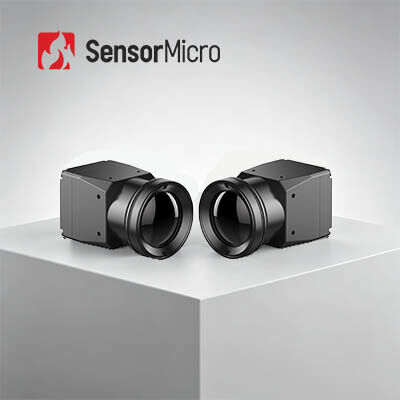
Uncooled LWIR 640x512 12μm Thermal Imaging Security Camera Core with 8-14μm Spectral Range

| Place of Origin | China |
|---|---|
| Brand Name | SensorMicro |
| Certification | ISO9001:2015; RoHS; Reach |
| Model Number | MICO612 |
| Minimum Order Quantity | 1 Piece |
| Price | Negotiable |
| Payment Terms | T/T |
Product Details
| Resolution | 640x512 / 12μm | NETD | <30mK |
|---|---|---|---|
| Camera Lens | Multiple Available | Frame Rate | 25Hz/30Hz/50Hz |
| Digital Video | USB /MIPI | Spectral Range | 8~14μm LW |
| Highlight | Thermal Imaging Security Camera Core,Thermal Imaging Security Camera 17um,640x512 Thermal Security Camera |
||
Product Description
Uncooled Thermal Imaging Security Camera Core LWIR 640x512 12μm
Product Overview
LWIR 640×512 / 12μm Uncooled Thermal Camera Module for Security and Monitoring
The MICO612 ultra-compact infrared camera core integrates a 640×512 mainstream resolution infrared detector, multiple optical lens options, image processing board, and robust structural frame. It transmits analog or digital video to backend platforms for seamless integration. With its larger array, the MICO612 meets diverse customer requirements.
Main Features
- Mainstream Compatibility, Cost-Effective: Equipped with self-developed 640×512/12μm wafer-level infrared detector for wide adoption. Integrated with dedicated ASIC chip for high energy efficiency.
- Optimized SWaP Design: Sectional dimension: only 22.2×22.2×27.2mm (excluding lens). Weight: just 30.3±2g. Low power consumption: 680mW.
- Easy Development & Quick Integration: Native analog or digital video output supporting CVBS/USB/MIPI standards—no additional development required. Easy mounting with minimal structural design effort.
Product Specifications
| Model | MICO612 |
|---|---|
| IR Detector | Sensitive Material: VOx |
| Resolution: 640×512 | |
| Pixel Size: 12µm | |
| NETD: ≤30mK/F1.0/25℃ | |
| Spectral Response: 8~14μm | |
| Optical Lens | Focus/F#: 4.8/F1.0 | 9.1mm/F1.0 | 13mm/F1.0 |
| FOV: 91°(H)×73°(V) | 47.7°(H)×38.2°(V) | 33°(H)×26°(V) | |
| Detection Range (8 pixels): 99m (5'11" tall person) | 360m (4m×3m vehicle) | |
| Type: Fixed Focus Athermal | First lens sealing/coating: IP67 | |
| Image Processing | Analog Video: PAL(default) / NTSC |
| Digital Video: USB / MIPI | |
| Frame Rate: 25Hz/30Hz/50Hz | |
| Start-up Time: ≤6s | |
| Image Algorithm | NUC/DRC/DNS/DDE/SFFC |
| Pseudo Color | 11 types - customizable |
| Electrical Interface | Standard External Interface: 3PIN (A1251-WV-S-3P) | 9PIN (A1251-WV-S-9P) | 26PIN (DF56C-26S-0.3V-51) |
| Video Interface: CVBS | USB | MIPI | |
| Power Supply: DC: 5V~24V | |
| Steady Power Consumption | ≤680mW@5V, 23±3℃ |
| Mechanical | Size: 22.2mm×22.2mm×27.2mm (L×W×H) | Weight: 30.3±2g |
| Environmental Adaptability | Operating Temperature: -40℃~+70℃ |
| Storage Temperature: -45℃~+85℃ | |
| Humidity: 5%~95%, non-condensing | |
| Vibration: Random Vibration, 5.35grms, 3-axis | |
| Impact: Half Sine Wave, 40g/11ms, 3 Axis, 6 Direction | |
| Certification: RoHS2.0/Reach |
Industrial Applications
The MICO612 thermal camera module can be integrated into security cameras with temperature monitoring from short to ultra distance applications, including PTZ Camera, Box Camera, and Speed Dome Camera systems.
Our Service Approach
Pre-Sales
Requirement Analysis
Scenario Assessment
Product Selection
Customized Solutions
Deployment
Rapid Delivery
System Integration & Testing
Technical Training
Application Guidance
Frequently Asked Questions
How does a thermal module work?
A thermal module operates through the following process:
- Infrared Detection: The thermal module contains an infrared detector that senses electromagnetic radiation in the infrared range.
- Optics: Infrared radiation is focused onto the detector through an optical system, which may include a lens or mirror array.
- Signal Amplification: The detected signal is amplified and digitized by internal electronics.
- Image Processing: The digitized signal is processed to produce a thermal image, involving noise reduction, contrast enhancement, color mapping, and potentially temperature measurement.
- Display: The thermal image is displayed on a screen, either within the module or on an external device.
The operation depends on the infrared detector type. Uncooled detectors use thermal effects where temperature changes from absorbed radiation are detected and converted to digital signals. Cooled detectors employ different mechanisms like photoelectric or thermoelectric effects.
Thermal modules serve various applications including medical, industrial, and security thermal imaging, and are integrated into devices such as handheld thermal cameras, surveillance cameras, and thermal scopes.
Recommended Products
