


All Products
-
Thermal Camera Core
-
Thermal Security Camera
-
Plug-in Thermal Camera
-
Cooled Infrared Detectors
-
Cooled Camera Modules
-
Optical Gas Imaging
-
Radiometric Thermal Module
-
High Resolution Thermal Camera Module
-
Thermal Camera For Fever Detection
-
Vehicle Mounted Thermal Camera
-
Integrated Dewar Cooler Assembly
-
Uncooled Infrared Detectors
Contact Person :
Wendy Wang
Phone Number :
+86 27 50185150
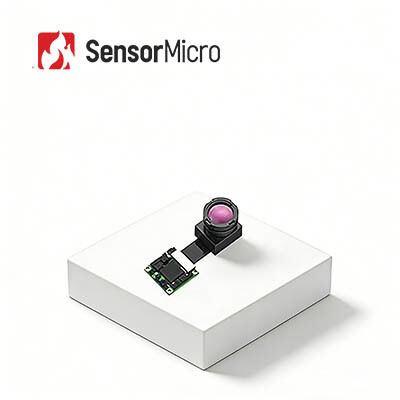
256×192 Resolution 12μm Pixel Pitch 330mW Low Power Consumption Thermal Camera Module

| Place of Origin | China |
|---|---|
| Brand Name | SensorMicro |
| Certification | ISO9001:2015; RoHS; Reach |
| Model Number | Mini212G2 |
| Minimum Order Quantity | 1 Piece |
| Price | Negotiable |
| Payment Terms | T/T |
Product Details
| Resolution | 256×192 | Pixel Pitch | 12μm |
|---|---|---|---|
| Temperature Measurement Range | -20℃~+550℃ | Power Consumption | 330mW |
| Temperature Measurement Accuracy | Greater Of ±2℃ / ±2% | Focus Mode | Focus Free |
| Highlight | 120x90 Thermal Camera Core,17μm Thermal Camera Core |
||
Product Description
Low Power Consumption 256×192/12μm Thermal Camera Module
Product Overview
The Mini212G2 uncooled infrared miniature module integrates a wafer level packaging 256×192/12μm uncooled infrared detector. Built on SensorMicro's self-developed TIMO212 infrared module, it features an integrated infrared ISP processing board that enables direct output of temperature matrices and thermal images, significantly reducing development workload for customers.
With compact size, low power consumption, and cost efficiency, this module supports multiple field-of-view configurations and integrates a universal control interface, enabling broad applicability across industries.
Main Features
- Miniature Module with Direct Thermal Imaging Output - Equipped with self-developed 256×192/12μm wafer-level infrared detector with significant cost advantages
- Ultra-Compact Design - Only 17×17mm (PCBA) in size, weighing as low as 4g, ideal for space-constrained applications
- Advanced Processing - Integrated ISP processing board and next-generation image algorithms deliver clear thermal images directly
- Precise Detection - High-precision temperature measurement with accuracy up to ±2℃; supports spot, area, and full-frame measurement
- Flexible Configuration - Multiple field-of-view lens options available to meet various observation requirements
- Rich Interfaces - USB2.0 / MIPI / DVP / BT.656 / LVDS digital video output interfaces, fully compatible with industry standards
Product Specifications
| Model | Mini212G2 |
|---|---|
| Resolution | 256×192 |
| Pixel Size | 12μm |
| Spectral Response | 8~14μm |
| NETD | ≤50mK |
| Output Data | 14bit Raw |
| Frame Rate | Thermography: 25Hz, Imaging: 50Hz |
| Focus Mode | Focus Free |
| Lens (HFOV/FL) | 17.5°/10mm | 25°/7mm | 56°/3.2mm | 90°/2.1mm |
| Weight (g) | 7.1 | 6.4 | 4 | 6.8 |
| PCBA Size (mm) | 17×17 |
| Digital Video Interface | USB2.0 / MIPI / DVP / BT.656 / LVDS |
| Analog Video Interface | CVBS (PAL/NTSC) |
| Operating Voltage | 3.3V±0.1V |
| Typical Power Consumption | 330mW |
| Temperature Measurement Range | -20℃~+550℃ (-20℃~+150℃ | +100℃~550℃) |
| Temperature Measurement Accuracy | Greater of ±2℃ / ±2% |
| Operating Temperature | -40℃~+70℃ |
| Humidity | 5%~85% |
| Storage Temperature | -45℃~+85℃ |
| Certification | RoHS 2.0 / Reach |
Industrial Applications
This product is designed for applications in AIoT, Machine Vision, Industrial Vision, Security Monitoring, and Night Observation:
- AIoT - Perfect for integration into compact AIoT devices including smart home appliances, wearable devices, and intelligent environmental monitors
- Industrial Vision - Real-time monitoring of industrial equipment, laser processing and welding scenarios, semiconductor detection, and more
- Security Monitoring - Detection of illegal intruders with real-time alarm triggering capabilities
Our Core Strengths
- Stable Supply - Reliable supply chain across our full ecosystem with quick response to market demands
- Sustaining Innovation - Expertise in detector manufacturing and system integration enables continuous optimization through product application feedback and technical upgrades
- Cost Advantage - Complete production chain management and efficient large-scale manufacturing deliver competitive pricing
Frequently Asked Questions
What is infrared thermography?
Thermography is a non-invasive diagnostic technology based on object surface temperature detection. The infrared radiation emitted from an object is recorded and visualized as a temperature distribution map.
What can infrared thermography be used for?
Infrared thermal imaging can be used for home inspections, structural defect identification, electrical and mechanical fault detection, physiological changes in people and animals, and many other applications.
What are the advantages of infrared thermography?
For non-destructive testing, it offers simple operation, quick response without damage, cost savings, increased work efficiency, and reduced manpower and equipment depreciation. For medical applications, it efficiently identifies hidden health issues with 100% safety (no radiation), making it ideal for early health screening.
Recommended Products
