


All Products
-
Thermal Camera Core
-
Thermal Security Camera
-
Plug-in Thermal Camera
-
Cooled Infrared Detectors
-
Cooled Camera Modules
-
Optical Gas Imaging
-
Radiometric Thermal Module
-
High Resolution Thermal Camera Module
-
Thermal Camera For Fever Detection
-
Vehicle Mounted Thermal Camera
-
Integrated Dewar Cooler Assembly
-
Uncooled Infrared Detectors
Contact Person :
Wendy Wang
Phone Number :
+86 27 50185150
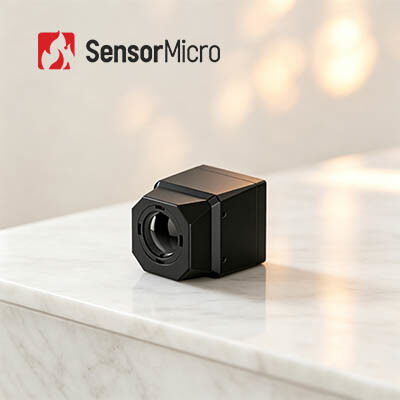
LWIR 256x192 12μm Uncooled Infrared Camera Module with 550mW Low Power Consumption for Thermal Imaging

| Place of Origin | China |
|---|---|
| Brand Name | SensorMicro |
| Certification | ISO9001:2015; RoHS; Reach |
| Model Number | MICO212 |
| Minimum Order Quantity | 1 Piece |
| Price | Negotiable |
| Payment Terms | T/T |
Product Details
| Resolution | 256x192 / 12μm | Supply Voltage | DC: 5V~24V |
|---|---|---|---|
| Typical Power Consumption | <0.75W | Weight | <16±2g |
| Spectral Range | 8~14μm | Steady Power Consumption | ≤550mW@5V, 23±3℃ |
| Highlight | Flexible Uncooled Thermal Security Camera,Uncooled Thermal Security Camera Module,LWIR Camera Module |
||
Product Description
LWIR 256x192 12μm Uncooled Infrared Camera Module for Thermal Security Camera
Product Overview
Engineered for industrial-grade thermal imaging integration, the MICO212 ultra-compact infrared camera core adopts a self-developed 256×192/12μm uncooled infrared detector and dedicated ASIC chip, achieving outstanding energy efficiency and reliable imaging performance. With compact dimensions of 22.2×22.2×28.4mm (excluding lens), lightweight body of 16±2g and ultra-low power consumption of 550mW, it delivers superior SWaP optimization. The module supports native CVSB, USB and MIPI video output with optional analog and digital signal transmission, requiring no additional development work.
Main Features
- Cost-Effective Solution: Equipped with self-developed 256×192/12μm uncooled infrared detector offering clear cost advantage with integrated dedicated ASIC chip for high energy efficiency
- Optimized SWaP Design: Ultra-compact size (22.2×22.2×28.4mm), lightweight (16±2g), and low power consumption (550mW)
- Easy Development & Quick Integration: Provides native analog or digital video output supporting CVSB/USB/MIPI standards with minimal structural design effort
Product Specifications
| Model | MICO212 |
|---|---|
| IR Detector | Sensitive Material: VOx |
| Resolution: 256×192 | |
| Pixel Size: 12µm | |
| NETD: ≤30mK/F1.0/25℃ | |
| Spectral Response: 8~14μm | |
| Optical Lens | Focus/F#: 10mm/F1.0-FF |
| FOV: 17.5°(H)×13.2°(V) | |
| Detection Range (8 pixels): 99m (5'11" person) / 360m (4m×3m vehicle) | |
| Type: Fixed Focus Athermal | |
| First lens sealing/coating: IP67/HD | |
| Image Processing | Analog Video: PAL(default) / NTSC |
| Digital Video: USB | |
| Start-up Time: ≤6s | |
| Image Algorithm: NUC/3D/2D/DRC/EE/SFFC | |
| Pseudo Color | 11 types - customizable |
| Electrical Interface | Standard External Interface: 3PIN (A1251-WV-S-3P) | 9PIN (A1251-WV-S-9P) |
| Video Interface: CVBS | USB | |
| Power Supply | Supply Voltage: DC: 5V~24V |
| Steady Power Consumption: ≤550mW@5V, 23±3℃ | |
| Mechanical | Dimension: ≤22.2mm×22.2mm×28.4mm (L×W×H) |
| Weight: <16±2g | |
| Environmental Adaptability | Operating Temperature: -40℃~+70℃ |
| Storage Temperature: -45℃~+85℃ | |
| Humidity: 5%~95%, non-condensing | |
| Vibration: Random Vibration, 5.35grms, 3-axis | |
| Impact: Half Sine Wave, 40g/11ms, 3 Axis, 6 Direction | |
| Certification | ROHS2.0/REACH |
Industrial Applications
The MICO212 thermal imaging module is applied to Thermography, Security Monitoring, Robots, Intelligent Hardware, ADAS, Firefighting & Rescue, and related fields.
Product Advantages
- Diverse Product Portfolio: Wide range of formats including infrared detectors, camera cores, and modules
- Rich Product Variety: Multiple array resolutions, pixel sizes, wavebands, and lens options combinations
- Outstanding Performance: Clear imaging, compact size, low power consumption, high sensitivity, and strong reliability
- Easy Integration: Multiple interface options for straightforward integration and rapid development
Frequently Asked Questions
What is the difference between uncooled and cooled IR detectors?
There are currently two types of infrared thermal imaging sensors on the market: cooled and uncooled.
Uncooled IR detectors operate at ambient temperature. Based on semiconductor technology, they can be fabricated in large volumes with small size and low cost, making them ideal for portable/handheld/mobile devices.
Cooled IR detectors are packaged in units that maintain extremely low temperatures using cryo coolers. They are larger, more expensive, and less reliable due to complex cooling systems, but offer incredible sensitivity and work with long focal length optics for long-range missions.
Recommended Products
